Episode 11: The Mad Scientist and the Traveling Preacher

In 1924, Charles Henry Schwartz, a married 35-year-old chemist from the Bay Area of California and father of three small children, took over an abandoned factory at Walnut Creek and started a business called the Pacific Cellulose Chemical Company. The community was intrigued after Schwartz explained that he had mastered a secret process for manufacturing artificial silk-- a process he claimed to have discovered in Germany during his stint as an Allied spy in WW1.
Schwartz, who was born in Germany, was an eccentric man-of-the-world who made many dubious claims-- that he had once held the rank of captain in the French army, that he had once been a New York City detective, that he had graduated from several different prestigious universities. While some questioned his background, few could question his genius as an inventor and chemical engineer, and for that reason Schwartz was highly-protective of his secrets, and lived in constant fear that someone would steal them.
But in the summer of 1925, it appeared that Schwartz could finally let down his guard. On July 30, he telephoned his business partner and president of the company, H.R. Kleinjung, and announced that his final experiment had been successful-- after months of trial and error he had perfected a chemical compound necessary for the cutting of synthetic silk fiber. The following morning, they would order the machinery and supplies that would put his secret into mass production.
But later that evening, just a few hours after he had announced his triumph, Schwartz's laboratory was rocked by a terrible explosion. The night watchman, Walter Gonzales, kept the flames at bay with a fire extinguisher until the fire department arrived. They determined that the flame of a carbide lamp had ignited chemical fumes. But while the building was saved, one life was lost. The accidental death of the wizard of Walnut Creek spread far and wide-- until authorities made a strange discovery: The charred victim had been murdered by a blow to the head.
Guy Spencer, the fire marshal, investigated the ruins and discovered that 6 torches had been made out of kerosene-soaked fabric and placed next to crates of highly-explosive chemicals. But one of the torches had failed to do its job. Spencer reported his findings to Sheriff Neale, who, in turn, notified District Attorney A.B. Tinning.

Tinning called up Dr. Edward Oscar Heinrichs of San Francisco, who was widely regarded as one of the world's greatest scientific detectives. Heinrichs raced to Walnut Creek before any valuable evidence could be lost. Dr. Heinrichs poked around the burned-out laboratory and realized something very funny was going on. "If this is a laboratory, it's the crudest affair of its kind I've ever seen. It was not fitted out for any serious research. No electricity. No gas, no running water! Not a thread of silk, either real or artificial, could ever have been made here."
Heinrich's theory was confirmed when he had a sample of Schwartz's miracle silk analyzed, and found that it had been purchased for $8 at a nearby store. With this spool of synthetic silk, Schwartz had duped dozens of investors-- including his own wife-- out of a small fortune. Had Schwartz been murdered by an investor who untangled the threads of the chemical engineer's silk scam? Police thought so, but Dr. Edward Oscar Heinrichs had a different theory.
The laboratory corpse had been taken to the police morgue in San Francisco. Armed with photographs of Charles Henry Schwartz, Dr. Heinrichs studied the body and noticed one feature which had not been disfigured by the flames. The right ear featured a congenital protuberance of cartilage known as Darwin's tubercle. Though Darwin's tubercle is not a rare feature, it is distinctive, and this led Heinrichs to make a shocking pronouncement-- the body pulled from the burning laboratory was not that of Charles Henry Schwartz.
Furthermore, Dr. Heinrichs was convinced that the killer had gone through great trouble to prepare the body to make it appear as if it had belonged to the eccentric inventor. Schwartz was missing two of his upper teeth, and the jaw of the victim had been chiseled to match. Acid had been poured on the victim's fingertips to make fingerprint identification impossible, and the eyes had been punctured to conceal their color.
Meanwhile, detectives had learned that Charles Henry Schwartz wasn't who he had claimed. His real name was Leon Henry Schwartzhoff, and he had never served as a spy or as a New York detective. But he was, however, being sued for $75,000 by Elizabeth Adam, a young Oakland hairdresser he had promised to marry. He had also taken out a life insurance policy worth $180,000 with a double indemnity clause, with his wife as the beneficiary.
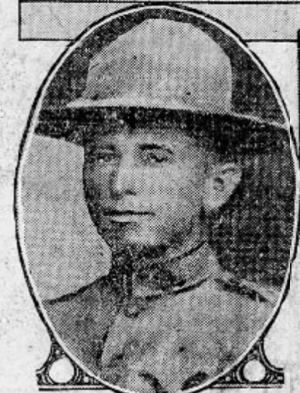
While police hunted for the missing chemist, Dr. Heinrichs set about the difficult task of identifying the victim. Returning to the laboratory, detectives found partially-burned religious pamphlets among the ruins, and, by using a microscope, Dr. Heinrichs was able to make out a signature on the burned paper-- G.W. Barbe. On August 8, an undertaker from Placerville, California, viewed the body and identified it as his friend, Gilbert Warren Barbe, a veteran who had become a traveling preacher after the war.
"This is as thorough an example of premeditation as I have ever seen," declared Dr. Heinrichs. "Schwartz must've planned it for months, and had to wait only for the right prospect to appear. He might've gotten away with it but for one mistake-- he was too eager by minutes."
Yes, the con man's great mistake was pouring benzol around his laboratory. Benzol fumes are heavy and take time to rise. Had he waited just a few minutes longer before starting the fire, the explosion would've completely obliterated the building and destroyed the body along with its tell-tale earlobe. Ironically, the chemist was done in by his own ignorance of chemistry.
Now came the manhunt for Charles Henry Schwartz. County Sheriff Richard R. Veale put up $100 of his own money as a reward for the chemist's arrest, while Koleman Kluck, a member of the board of directors of the Pacific Cellulose Company, posted $500. Governor Richardson of California offered $1000 out of a special fund appropriated for the apprehension of dangerous fugitives. Anonymous tips flooded in from every part of the Bay Area, but Schwartz remained at large.
One reason why the killer chemist was so hard to track down was because Schwartz had used multiple aliases over the years. To the young Oakland hairdresser he promised to marry, he was known as Charles Henry Stein. In Europe, he was Leon Henry Schwartzhoff, while he rented a safe deposit box at an Oakland bank under the name of H. Orchard. He also liked to keep souvenirs from people he had known in order to throw authorities off his trail; some of the people who knew him observed that Schwartz often wore a belt buckle engraved with the letter W, though no one ever thought to ask why. The significance of the letter W would soon become clear.

Months before the explosion, Schwartz had approached an acquaintance by the name of C.W. Hayward, who was the manager of the Nottingham Apartments on 41st Street in Oakland. Hayward knew him as "Harold Warren", a seller of bootleg liquor. Schwartz told Hayward that he may need a place to hide out someday, and Hayward agreed to rent him an apartment whenever that time came.
At 4 o'clock on the morning of July 31, just hours after the explosion at the Pacific Cellulose Chemical Company laboratory, Schwartz awakened his old acquaintance.
(knocking on door)
"Hayward! Hayward!"
"Who is it?"
"It's me, Warren. Let me in. I just wrecked my car and there was booze in the backseat."
Hayward gave Schwartz an apartment key. In the morning, he packed a suitcase with clothing and maps of Mexico and then purchased a train ticket to Barstow in Southern California. And then he picked up a copy of the morning paper-- and saw that his plan had failed. He now realized that it would be foolish to attempt a border crossing. Every road, every bus station and every railroad depot would be under surveillance. He had no choice but to remain holed up inside his apartment.
A week passed by. Schwartz, wisely avoiding restaurants, ate his meals with Mr. and Mrs. Hayward. But Mrs. Hayward took notice of their tenant's nervous behavior and began to suspect that he might be worried about something far more serious than a liquor law violation. Mrs. Hayward, who had read about the Walnut Creek explosion, noticed that Harold Warren seemed to fit the description of Charles Henry Schwartz. She reported her suspicions to the police.

At 3 o'clock on the morning of August 9, 1925, Captain Lee of the Oakland Police Department arrived at Schwartz's apartment, accompanied by a squad of assistants and the landlord, C.W. Hayward. While his men guarded all possible exits, the landlord knocked on the front door.
"Harold, it's me, Hayward. I'd like to see you for a minute. Harold?"
After a moment passed with no response, officers began to break down the door, but as they crashed into the apartment, they heard a gunshot. They found Schwartz on the sofa, with a German army revolver by his side. He had shot himself through the right eye. He died on the way to the hospital without uttering a word.
On a table near the body was a suicide note addressed to his wife, Alice, in which he made a full confession of the murder. Other articles found on Schwartz's body included a small hand mirror of the type used by dentists, several keys, a package of chewing gum, an identification medal belonging to his wife's first husband, and a belt buckle engraved with the letter W.
Ultimately, Charles Henry Schwartz may not have found the secret of synthetic silk, but he did succeed in finding 15 minutes of infamy.


Comments