Ep 10: Star Spangled Insanity
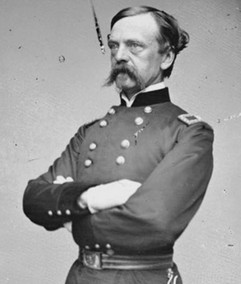
This is the true story of a self-taught lawyer whose never-before-used defense not only saved him from execution, but turned the entire judicial system on its head.
On the afternoon of Saturday, February 27, 1859, the nation's capital was thrown into a state of excitement over an incident which took place at Lafayette Square. At 2 o'clock, two distinguished gentlemen met each other on the square. One offered his hand for a handshake, the other refused. Instead, he put his hand in his pocket and drew a pistol. As the wounded victim reeled from the shot he advanced on his attacker, who fired a second shot. And finally, aiming for the groin, the man fired a third shot, before casually walking away. Stunned onlookers dragged the victim into a nearby club house, where he died.
The victim of the Lafayette Square shooting was Philip Barton Key, United States Attorney for the District of Columbia. His killer was 40-year-old New York congressman Daniel Edgar Sickles. But what was the cause of friction between these two powerful and esteemed gentlemen?
Daniel Sickles was a rising political star. He began his career as a printer, saving his money to purchase law books, which he studied every night. He attended law school and passed the bar exam and quickly climbed the ladder of success, becoming counsel for the city of New York. In 1856 he ran for Congress and won. In the meantime, he had married Teresa Bagioli, a beautiful girl who was the granddaughter of a renowned opera composer. Teresa was just 15 years old when she met Sickles, who was 17 years older and regarded as a serial womanizer. They married in 1852, amid protests from the Bagioli family.

Teresa was 20 when she and her husband relocated to Washington and she soon became the reigning queen of the city's social circle, but because of her youth, she eventually grew tired of the dinner parties and fancy dress balls. She was also bored at the Sickles mansion, with only butlers and maids and their infant daughter, Laura, to keep her company during the day.
Teresa first met 42-year-old Philip Barton Key at the Inaugural Ball of 1857. Key, at the time, was a close friend of Daniel Sickles. Tall, confident and charming, Philip Barton Key-- who was the son of Star Spangled Banner lyricist Francis Scott Key-- was the polar opposite of Sickles, who was known to be a bit thick-headed and insensitive. After the ball, Key began visiting the Sickles home with greater frequency. Before long, Teresa was taking carriage rides with Key and spending more time alone with him than any married woman should, though she explained there was no need to read too much into it; Key was a lonely man, his wife, Ellen, had died recently from an illness.
The husband's personal clerk, however, knew the real story, but when George Woolridge tried to tell Sickles about the affair, Sickles refused to believe it.
"Mere gossip, George. Philip Barton key is a man of honor. I trust him as implicitly as I do my wife." Sickles, however, was worried about his wife's reputation should such rumors continue to spread, and he assured his clerk that he would speak to Key about it.
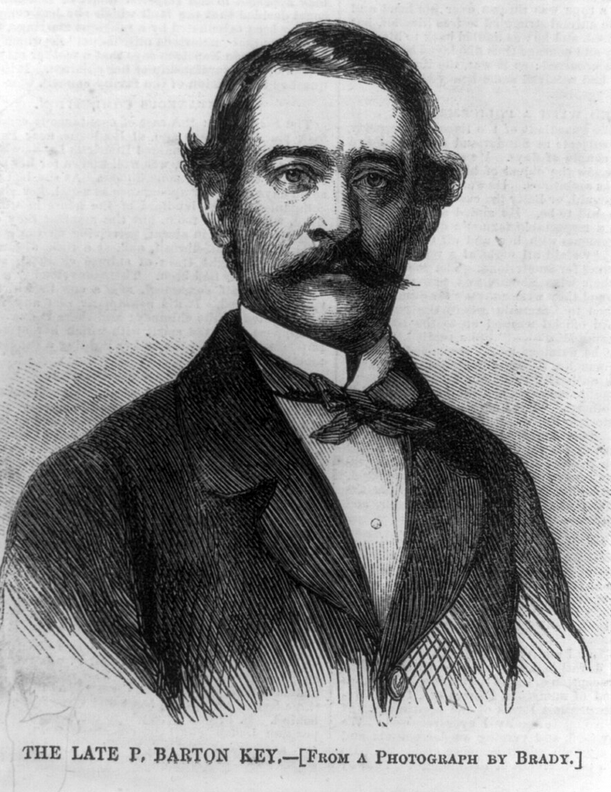
Things soon changed, or so Daniel Sickles believed. The carriage rides were no more, and Key began visiting the mansion less frequently. But then, a domestic servant informed Sickles that Key frequently stood outside Teresa's window, waving a handkerchief. This, the servant believed, was a secret signal between lovers. Around that same time, Sickles also received a letter, signed only with the initials R.P.G. The letter, dated February 24, 1859, provided irrefutable evidence of an affair between Philip Barton Key and Teresa Bagioli Sickles.
Early the next morning, Sickles went to 383 West 15th Street, the address of the rented house which the mysterious R.P.G. claimed was the lovers' secret trysting spot. Sickles made inquiries and learned that, sure enough, the house was being rented by none other than Philip Barton Key. Further inquiries established the fact that a woman matching Teresa's description frequently visited.
Daniel Sickles was thunderstruck, but still he wasn't thoroughly convinced. Perhaps the visitor had been another woman. He convinced his clerk, George Woolridge, to rent a room in a building across the street from the house on West 15th Street and keep a careful watch. When Woodridge made his report to Sickles, the New York congressman turned deathly pale, then wept so loudly that Woolridge, embarrassed by the scene, fled the room. Later that evening, Bridget Duffy, one of the servants, heard the sounds of shouting coming from Teresa's room. She crept upstairs and peeked through the half-opened door. Teresa sat at her writing desk, weeping over a pad of paper. Sickles towered over her with a wild glow in his eyes, his hair disheveled, his fists clenched.
"Write it down!" he demanded. "Every single word that you confessed to me. I want it on paper. Write it down, now!"
She complied, and as she wrote out the details of her 8-month affair, Sickles noticed that she was no longer wearing her wedding ring.
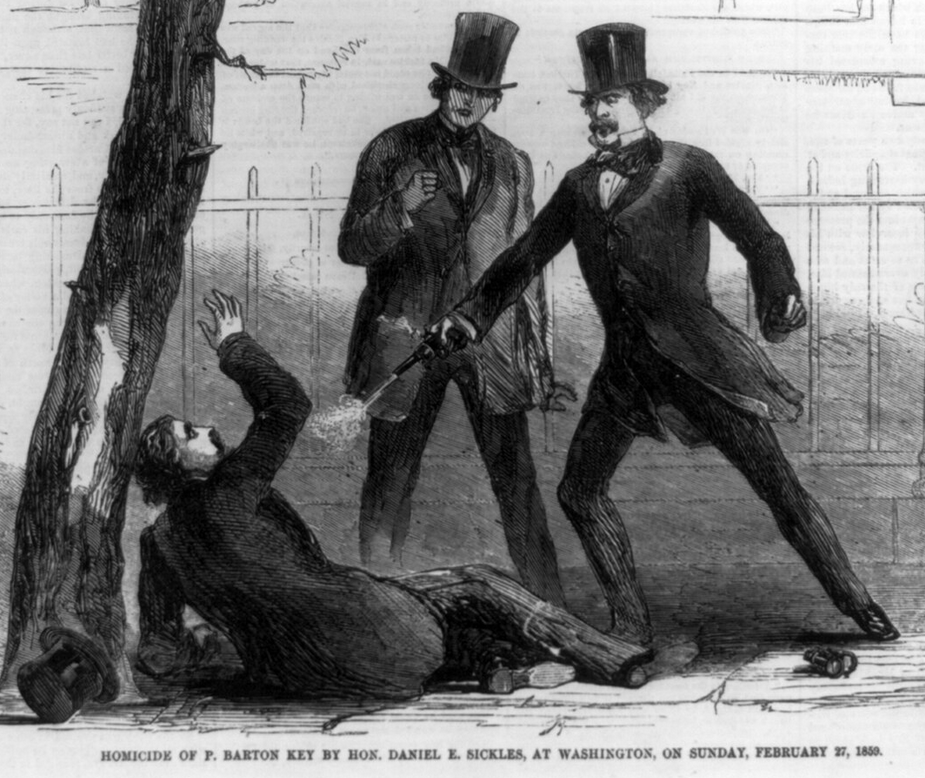
Understandably, the following afternoon, when Daniel Sickles looked out the window and happened to see his old trusted friend waving a handkerchief, he went a bit off the deep end. He grabbed two derringer pistols and a revolver and went outside to confront Key. It was only a few minutes later when members of the Cosmos Club, attracted by the sound of gunshots, dragged the victim's body inside.
Surprisingly, instead of being reviled as a cold-blooded killer, Daniel Sickles became something of an overnight hero. To his jail cell were delivered letters of congratulations, bouquets of flowers, cards and candy and other gifts. The warden even apologized to Sickles for not being able to get him a bigger cell, and, at the murder trial, dozens of prospective jurors had to be dismissed because they felt that Sickles had done the right thing. After all, it wasn't as if he had taken his rage out on his wife.
This outpouring of support gave Sickles an audacious idea. He conferred with his attorney, James T. Brady, who, in his opening argument, insisted that homicide was justifiable under extreme circumstances, and even if it wasn't, Sickles had been driven to commit the crime by a combination of anger and despair at the time of the shooting. It was the first time in the history of the American judicial system that insanity was used as a defense. And it worked. After the 20 day trial, the jury needed just 72 minutes to deliberate, returning a verdict of "not guilty". The self-taught lawyer had outwitted the best prosecutors in Washington DC.
After the trial, Daniel Sickles and Teresa Bagioli Sickles went their separate ways, and Teresa died of tuberculosis seven years later at the age of 31. Their daughter, Laura, devastated by a tragic love affair of her own, died in a run-down boardinghouse in Brooklyn at the age of 38.
As for Daniel Sickles, the murder trial only boosted his popularity, especially after Teresa's confession was printed, word for word, in newspapers across the country.
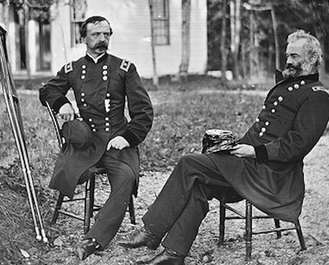
Sickles wasn't even forced to resign from Congress, and when the Civil War broke out, he saw it as an opportunity to repair his public image. Using his political connections, he organized four regiments for the Union Army before being promoted to brigadier general. In January of 1863, President Lincoln nominated Sickles for a promotion to the rank of major general, which raised a bit of controversy, as Sickles, unlike other Union generals, hadn't matriculated from West Point.
At the Battle of Gettysburg, Sickles was wounded by a Confederate cannonball. His right leg was mangled and had to be amputated. Sickles took possession of the severed limb, had the bones preserved, and shipped them off in a miniature coffin to a museum in Silver Spring, Maryland. Sickles' leg is still on display at the National Museum of Health and Medicine, and, according to legend, Sickles made a trip to the museum every year on the anniversary of his amputation to visit his amputated limb.
"He was more fond of the leg he lost than the one he had" once remarked Mark Twain.
After serving as a general in the Civil War, Daniel Sickles was appointed commander of the Second Military District, which was a temporary administration established by the Department of War to rebuild the war-ravaged south. He played a pivotal role during the Reconstruction, and became an outspoken advocate for the fair treatment of African-Americans. This would ultimately lead to his dismissal by President Andrew Johnson, who believed that ending slavery was one thing, but granting rights to blacks was a step too far.
After Johnson was succeeded by Ulysses S. Grant in 1869, Daniel Sickles was appointed ambassador to Spain, where he was rumored to have had an affair with Queen Isabella II. But his reputation as a playboy came to an end when he met and fell in love with a Spanish noblewoman named Carmina Creagh. They were married in 1871.
Upon his return to New York is 1874, Sickles amassed a considerable fortune in the stock market and moved into a Lafayette Square mansion-- while also finding the time to serve as the sheriff of New York City, after the sitting sheriff, James A. Flack, was forced to resign amid corruption allegations.
He then succeeded in making an unlikely return to politics in 1892, when he was again elected to congress. He passed away in 1914, living to the ripe old age of 94. Despite his many accomplishments, however, Daniel Sickles is best remembered for the infamous act of killing Philip Barton Key, and, as a consequence, becoming the first defendant in a murder trial to use insanity as a defense.
Author F. Scott Fitzgerald is often misquoted as saying that there are no second acts in American lives. Daniel Sickles definitely would've objected to such a statement. From congressman to killer, war hero to diplomat, stock trader to sheriff, paramour to European royalty to a macabre museum specimen, the man known to friends and enemies alike as "Devil Dan", didn't just have a second act-- he had more lives than a cat.


Comments