Ep 7: The Kidnapping of Betty Ann Lake

On the morning of Monday, January 6, 1936, near the tiny settlement of Pacific Junction in New Brunswick, Canada, a middle-aged woodcutter named Otto Blakeney saw smoke over the snowy horizon. He trudged through the woods and was shocked to discover a burned-out cabin.
Six days earlier, on New Year's Day, Blakeney had come to this same cabin, which was occupied by 29-year-old Philip Lake and his family, to pick up his mail and provisions, and now he had returned for the same purpose, only to find the tiny two-room cabin deserted. He wondered what had become of Philip Lake and his wife, Bertha, and their two infant children, a boy named Jackie and a baby girl, Betty Ann.
Blakeney walked among the wreckage, marveling at the contrast of charred black wood against the pristine whiteness of the freshly fallen snow. He recognized what was left of the kitchen, and among the ruins he recognized what was left of Philip Lake.

Then he spotted a set of footprints in the snow, made by someone who was barefooted. His thoughts turned to Philip's wife and children.
A few yards from the burned cabin he found drops of blood. Further along he found a nursing bottle filled with frozen milk. And a few steps later he found Philip's wife, Bertha, dead on her back in her nightclothes, a deep gash on her forehead. Here he uncovered two sets of adult footprints. He followed the trail and discovered 21-month-old Jackie, face down in the snow. The child had apparently frozen to death. Otto Blakeney continued following the trail, but was unable to locate the youngest child, 5-month-old Betty Ann. Surely, the baby couldn't have survived the brutal January cold, and the nearest house was miles away.
Blakeney continued to trudge through the frosty wilderness, wondering what sort of monster had descended upon Pacific Junction, wondering who would want to murder the Lake family. Philip, tall, rugged and handsome, was a former sailor from Newfoundland, who had settled down on the mainland to stake out a new life for himself and his young family. His wife, Bertha, had married Philip after separating from her first husband, bearing him two healthy children. But little Betty Ann, with her round cheeks, bright eyes and dark hair, was the pride of Pacific Junction. She looked just like a living doll, it was said.
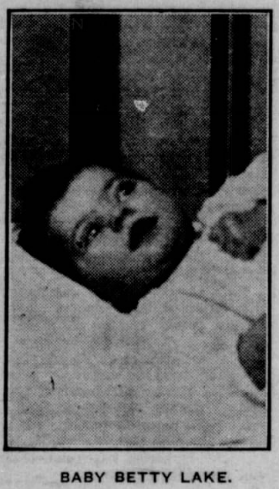
Two miles later Otto Blakeney reached the home of Omer Lutes, a station agent for Canadian National Railways. Lutes telephoned the police at Moncton, just a few miles away. Then Lutes, along with his nephew, Carl Horseman, and Blakeney, returned to the scene of tragedy.
Inspector John C. Bird of the Royal Canadian Mounted Police arrived, accompanied by a handful of officers. They asked if Philip Lake had any enemies. The men scoffed at the suggestion, for Lake was a well-liked man, they couldn't think of anyone who would wish him harm. But Omer Lutes recalled that his dog had begun to bark shortly after midnight and had continued to bark and growl for fifteen minutes.
Sergeant Bedford Peters followed the double set of footprints, which led through the brush in the direction of the Canadian National Railways tracks. Along the way, he found a worn leather mitten. Across the tracks, he picked up the trail again and followed them as far as the Berry Mills station, where they mingled with dozens of other footprints.
The autopsies revealed that Bertha Lake had died from a fractured skull; her husband had died from a bullet to the brain. Jackie, their infant son, had died from hypothermia. Earl O'Brien, a local youth, told authorities he had been around the cabin in recent days and when asked about visitors, he mentioned Otto Blakeney, 18-year-old Arthur Bannister and Arthur's 15-year-old sister, Frances. Arthur and Frances were the children of 43-year-old May Bannister, an impoverished family who lived on Berry Mills Road. She, too, had visited Philip and Bertha Lake. Earl O'Brien didn't know why the Bannisters had come to visit, but the woodsman, Otto Blakeney had an idea.

Blakeney recalled that, several months earlier, not long after Betty Ann was born, Philip had told him that the Bannisters wanted to adopt the child. Philip Lake laughed at the time, thinking it was a joke. Sergeant Peters, however, decided to investigate this offhand remark made months earlier. He questioned neighbors of the Bannister family, who agreed that it must've been merely a joke. Why should May Bannister want to adopt a baby? She had just gone away in December for a couple of weeks and had returned with a newborn daughter of her own.
Sergeant Peters pondered this information. He knew that May Bannister and her husband had separated ten years earlier. He wondered who the father of this newborn baby could be. Rumor had it that this man was a junk dealer named Milton Trites, who lived on the other side of the hill from the Bannister home. May had once worked as Milton's housekeeper. Milton Trites was interviewed by Constable Alexander Ewing.
"Yes, I'm the father," admitted Trites. "May told me in November she was going to have a baby, and I paid all the expenses. She came back with the baby on December 29, but she wouldn't let me see Thyra for two days. May said she didn't want the kid to catch any of my germs."
When asked if he had actually seen this baby, Trites said yes, but admitted that it was covered in blankets.
"She was asleep. Looked just like a doll in her crib."
Constable Ewing and Constable J.H. Pettigrew also questioned a social worker named Albert Powell, who had been a frequent visitor to the Bannister home. Powell first met May Bannister in 1934, after he learned that the family needed relief. He brought groceries and supplies regularly for a while, until May accused him of inappropriate conduct with her daughter, Marie, who was 13 at the time. Powell emphatically denied this accusation and, when asked about the new baby, Powell said that he didn't believe there was a new baby.
"I don't believe it's a baby at all, but a doll. She fooled Milton Trites with it so she could get money out of him, just as she tried to get money out of me."
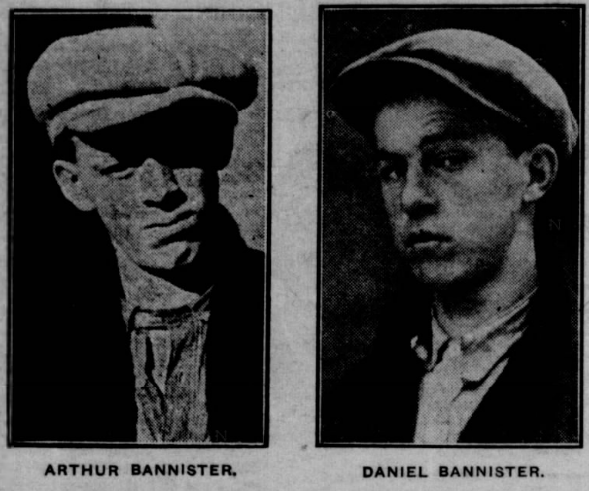
Inspector Bird, meanwhile, had learned that May had attempted to adopt a baby at the New Brunswick Protestant Orphan's Home in February, 1935. Her daughter Frances had filled out the application, which was denied on grounds of poverty. Months later, 18-year-old Arthur Bannister and his 21-year-old brother Dan paid a visit to the Lake family and suggested that Betty Ann be given up for adoption.
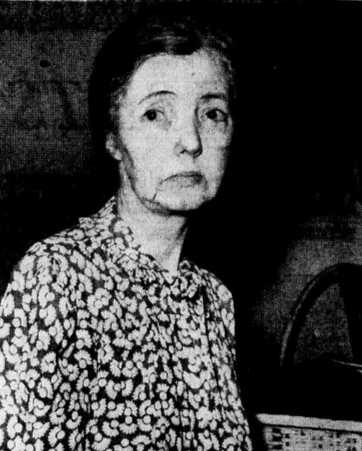
On January 9, Constables Ewing and Pettigrew, accompanied by policewoman Maud LeBlanc, paid a surprise visit to the Bannister home, and made two important discoveries-- an infant-sized doll and the very real Betty Ann Lake. May Bannister insisted that Betty Ann was her biological daughter, but the child was identified through a distinctive birthmark. May Bannister was placed under arrest.
It was 15-year-old Frances Bannister who broke down and told the authorities what had happened that led to the burning of the Lake family cabin. She and Arthur had gone to kidnap Betty Ann on the night of January 2, but couldn't go through with it. Three days later, on Sunday, they returned, Arthur armed with a .22 rifle and older brother Dan armed with a hunting knife. Frances waited outside. She heard only one shot. Then Arthur came out, holding Betty Ann.

"He handed the baby to me, and I ran to the road while Arthur set fire to the house," she said.
"Then I heard a woman screaming. The screams went on, then stopped suddenly."
Frances took the officers to the spot where the rifle had been discarded. A ballistics expert later matched the gun with the bullet which had killed Phillip Lake. His wife, Bertha, had run out of the burning cabin with Jackie, only to be bludgeoned with the butt of the rifle. Jackie was left to freeze to death. At the ensuing trial, which opened in Dorchester on March 4, Frances Bannister was the star witness for the Crown.
Meanwhile, Betty Ann was put into the custody of prison officials before being placed with her aunt and uncle, Edwin Cuthbertson and Bessie Lake Cuthbertson, in Barker's Point, New Brunswick. The Cuthbertsons would raise her as their own daughter.

Both of the Bannister boys were convicted of murder and sentenced to death, and their mother, May Bannister, was charged with kidnapping. She was ultimately convicted of only one charge, the relatively minor charge of harboring a stolen child.
On September 22, 1936, relatives trickled into the Westmorland County jail to bid a final farewell to Daniel and Arthur Bannister. Their mother, meanwhile, was confined behind the steel bars of the Kingston Penitentiary to await her fate. But for May's wayward sons, fate was about to lead them into a double grave which had already been dug on the stony hillside behind the jail

Meanwhile, a large crowd gathered in the Dorchester town square, growing larger with each passing hour. By midnight, the square was jammed with spectators, reporters, and Mounties on horseback, their scarlet uniforms the only dash of color on this drab, somber evening. The reporters attempted to gain access to the jail, where the double execution was about to take place, but were turned away at the door by Sheriff Killiam.
At 1:06 a.m., September 23, Canada's chief executioner, Arthur Ellis, sprang the trap and Daniel and Arthur were hanged for their crimes on the same gallows. Reporters weren't allowed to witness the double hanging, but those who were present said the Bannister boys went to the scaffold defiantly. Daniel insisted that he was innocent, and with his final words declared that he was being hanged for a crime he didn't commit. As for Arthur, just mumbled incoherently when the executioner lowered the black cap over his head.
Outside the county courthouse, a black flag was raised-- a stark reminder to the assembled masses that an execution had just taken place, that justice had been carried out. But had it been?
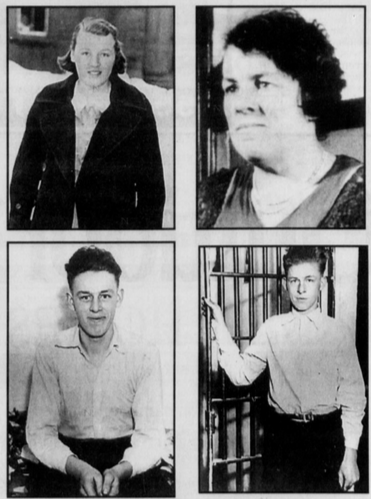
May Bannister, the mastermind of the diabolical plot whose actions ultimately led to the deaths of five people and the orphaning of an innocent child, was sentenced to just three and a half years in prison. Even the judge who presided over her trial lamented the leniency of the sentence, but the jury had made up its mind.
But while May Bannister managed to save herself from a long prison sentence, she couldn't save herself from 15 minutes of infamy.

What happened to Betty Ann? As it turned out, she went to live with her father's sister, Bessie Lake Cuthbertson, in Fredericton, New Brunswick. She was adopted by the Cuthbertsons and eventually married. But, sadly, she was in poor health most of her life, and died in 1991 at the age of 55.

Comments